
 Quick Enquiry
TL;DR
|
If your business is simple, your budget is tight and you are comfortable spending a weekend learning a new tool, a DIY builder is a reasonable choice. If you need the site to generate leads, integrate with other systems, or hold up against competitors who invested properly, a professional designer earns their fee back quickly.
The honest answer depends on where your business actually sits, not on which option sounds cheaper on paper.
What DIY Website Builders Actually Do Well
Tools like Wix, Squarespace and Shopify have improved enormously. For a straightforward brochure site, a solo consultant’s portfolio, or a very early-stage idea you are still validating, they genuinely work.
- Low upfront cost, usually a monthly subscription rather than a project fee.
- No developer needed to make basic changes yourself.
- Fast to launch, often within days rather than weeks.
If that description matches where your business is right now, do not let anyone talk you out of starting there.
Where DIY Starts to Break Down
The limitations show up later, usually once the business has grown past the point the template was designed for.
- Templates limit how your site is structured for search engines, which caps how well it can rank as competition increases.
- Custom integrations, booking systems, stock feeds, CRM connections, become difficult or impossible without significant workarounds.
- Every DIY site on the same builder tends to look and behave similarly, which makes it harder to stand out once your market gets more competitive.
- Your own time is the real cost. Hours spent fighting a template are hours not spent on the business itself.
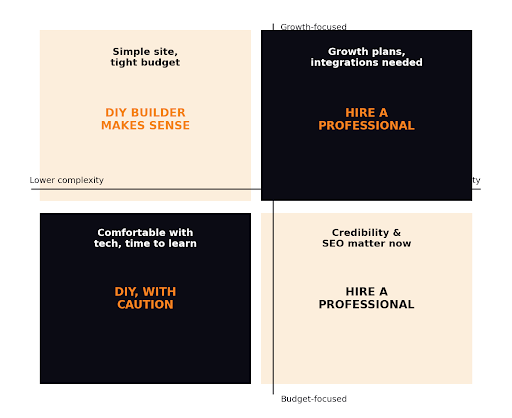 A simple way to place your own business before deciding.
What a Professional Designer Adds That Templates Do Not
The value of hiring someone is not really “a nicer looking website”. It is everything underneath the visible layer.
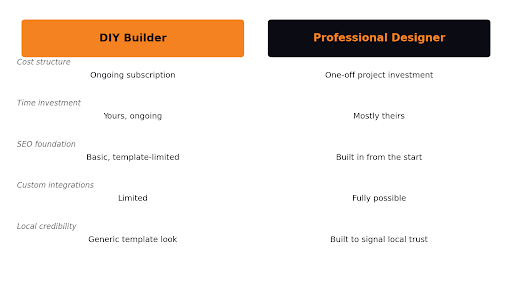 Where the two options genuinely differ, beyond the price tag.
A properly built site includes structured data, clean internal linking and a technical foundation that supports growth, the same fundamentals we cover in our web design service and in our piece on entity SEO. None of that is impossible on a DIY builder, but it is far more limited, and far more manual to get right.
The Real Cost Comparison
Most people compare a DIY builder’s subscription against a designer’s quote and stop there. That comparison misses the two costs that actually matter most, and it skips the fact that a professional quote depends heavily on what your site actually needs to do.
| THE COST MOST PEOPLE MISS Your own time has a value, even if you are not paying yourself an hourly rate for it. And a site that does not convert visitors into enquiries is not actually the cheaper option, no matter what it costs to build. |
If you already have paid work and limited spare hours, the time cost of building and maintaining a DIY site yourself is often higher than it looks. If you have more time than budget right now, that calculation flips.
Rather than a fixed price, what actually determines the cost of a professional build is a handful of specific factors.
- Number of pages and how much original content needs to be written versus supplied.
- Whether the site needs ecommerce, bookings, or integration with other systems such as a CRM or stock feed.
- How much custom design work is involved versus working from an established template structure.
- Ongoing needs after launch, such as SEO, content updates or maintenance.
Any agency worth hiring should be able to walk you through which of these apply to your business specifically, rather than quoting a number before understanding what you actually need.
A Simple Decision Framework
Score your own situation honestly against these four questions before deciding.
- Budget. Can you comfortably absorb a one-off project cost, or does a monthly subscription fit your cash flow better right now?
- Time. Do you have real spare hours to learn a builder and maintain the site yourself, or is your time better spent running the business?
- Complexity. Does the site need bookings, ecommerce, integrations or anything beyond static pages and a contact form?
- Growth plans. Are you validating an early idea, or are you already committed to growing this business over the next few years?
Two or more answers pointing toward budget, time and simplicity favour a DIY builder. Two or more pointing toward complexity and growth favour hiring a professional.
Does It Matter If Your Designer Is Actually Based in Dublin?
This comes up a lot from Dublin business owners, and the honest answer is: less than you would expect.
What actually matters is whether the person building your site understands the Dublin market, includes accurate local business information, and sets up your Google Business Profile and local signals correctly. A remote designer who does that properly serves you just as well as one working from a Dublin office. A local designer who skips those fundamentals does not serve you better just because of the postcode.
We work with businesses across Dublin remotely from Cork, and the process is the same either way. See our Dublin web design page for how that works in practice.
Common Mistakes We See
- Starting on a DIY builder for a genuinely complex business, then paying twice once a rebuild becomes unavoidable.
- Hiring a professional before validating whether the business idea has real demand, when a DIY builder would have answered that question more cheaply.
- Assuming a local Dublin designer automatically means better local SEO, without checking whether they actually set up Google Business Profile and local schema correctly.
- Comparing sticker price only, without factoring in the hours a DIY build will actually take.
Frequently Asked Questions
Is a DIY website builder good enough for a small Dublin business?
For a simple site with a tight budget, yes. It becomes limiting once you need custom integrations, stronger SEO, or a site that can grow with the business.
How much does it cost to hire a professional web designer versus using a DIY builder?
DIY builders run on an ongoing subscription. A professional build is typically a one-off project investment, and the exact cost depends on page count, whether ecommerce or integrations are needed, and how much custom design and content work is involved. A proper quote should be based on your specific requirements, not a fixed number.
Do I need a Dublin-based designer if my business is in Dublin?
No. What matters is whether your designer sets up accurate local information and Google Business Profile correctly, not their physical location.
Can I start with a DIY builder and move to a professional site later?
Yes. This is a common and reasonable path, especially for validating a new business idea before committing to a larger build.
What is the biggest risk of choosing the wrong option?
Choosing DIY for a business that has already outgrown it, leading to a rebuild later, or hiring a professional before the business idea is validated, spending more than necessary too early.


 Quick Enquiry