
 Quick Enquiry
TL;DR
|
Markdown is a lightweight, plain-text formatting style. No design, no JavaScript, just headings, lists and links stripped back to their simplest form. The idea getting discussed lately is whether serving a Markdown version of each page, alongside the normal HTML one, helps AI tools read and cite your content more easily.
It is a reasonable question to ask. It is not yet a reasonable thing to act on without checking your own evidence first.
Where This Idea Came From
The conversation picked up after a website owner asked publicly whether anyone had actually seen a benefit from offering Markdown files to large language models. Google’s John Mueller responded with his own experience testing this on sites he manages.
The gist of what he found: the only crawlers requesting the Markdown versions of his pages turned out to be SEO monitoring tools checking whether the feature worked, not genuine AI bots out in the wild. He also flagged a practical snag. Many hosting setups do not make it easy to inspect and respond to the request headers that would tell you whether a bot actually wants the Markdown version, so you often end up configuring it manually and checking your logs by hand.
That is the useful part of his answer. Not a verdict on whether Markdown helps or hurts, but a reminder to look at your own evidence before building for a problem you have not actually confirmed exists.
| “Before building infrastructure for a problem, check whether the problem actually exists in your own server logs.” |
Why AI Companies May Not Want Your Markdown Anyway
There is a useful, older parallel here. Meta keyword tags used to let site owners tell search engines directly what a page was about.
Search engines stopped trusting them within a few years. Site owners and SEOs abused them constantly, stuffing them with terms, misspellings and phrases that never appeared anywhere in the actual content. The signal became worthless because it was self-reported and unverified.
The same incentive problem applies to a Markdown file built specifically for AI consumption. If a business controls both what a visitor sees and what an AI bot reads, nothing stops those two versions from saying different things. Search and AI companies already know how to crawl and parse ordinary HTML reliably. Asking site owners to hand-prepare a separate, unverified version of the same content does not obviously make an AI system’s job easier or more trustworthy.
This is the same trust problem Google’s own documentation on structured data is built to avoid. Structured data is verifiable against the page it describes. A separate Markdown file is not, at least not without extra tooling most sites do not have.
Where Markdown Does Have a Genuine Use Case
The confusion in this conversation is that “Markdown for AI” actually covers two very different things, aimed at two different audiences.
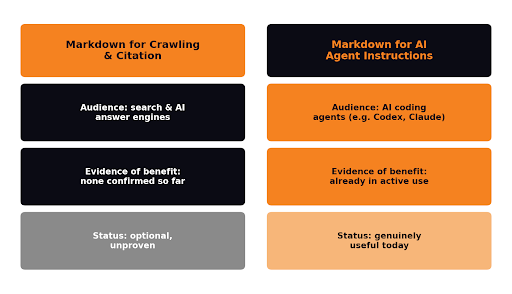 Two different things get called “Markdown for AI”. Only one has evidence behind it.
- Markdown for crawling and citation. Serving a Markdown version of a public page so an AI search tool can read it more easily. This is the part with no confirmed benefit so far, and the part Mueller was specifically asked about.
- Markdown for AI agent instructions. Structured files such as AGENTS.md, used by AI coding tools to hold project context, coding standards and task instructions. This is a different, genuinely useful application, already in active use by tools like OpenAI’s Codex and Anthropic’s Claude.
One is aimed at a search or answer engine trying to understand your business from the outside. The other is aimed at an AI agent trying to follow instructions inside a specific project it already has access to. Treating them as the same trend, because they both involve the word “Markdown”, is where a lot of the current advice goes wrong.
The Cloudflare Counter-Argument, and Why We’re Not Convinced Yet
Not everyone reads the evidence the same way. Cloudflare has built infrastructure that automatically converts HTML to Markdown on request, on the basis that Markdown is becoming a common format AI systems ask for.
That is a reasonable bet for a company operating at Cloudflare’s scale, where they can see aggregate request patterns across millions of sites that a single business never could. But a public discussion prompted by their announcement produced very few site owners describing an actual, measurable citation improvement from having it switched on. Confirmed technical capability and confirmed commercial benefit are not the same thing, and right now the evidence sits closer to the first than the second.
What We Would Actually Recommend
Before spending development time on a Markdown version of your site, check whether it is solving a problem you actually have.
- Look at your own server logs for the user agents of known AI crawlers, and confirm whether they are requesting anything beyond standard HTML.
- If you are not seeing genuine AI bot traffic asking for an alternate format, there is no current evidence a Markdown version would change your AI visibility.
- Put that development time into the things with a track record instead.
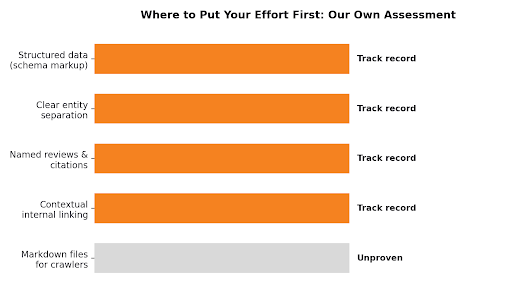 Where we would put the budget first, based on what currently has evidence behind it.
This is the same principle behind the entity structure and internal linking work we cover in our piece on entity SEO, and behind Google’s own guidance on making a page’s purpose unambiguous through schema.org markup. Evidence first, infrastructure second.
A Quick Way to Check Your Own Logs
You do not need specialist tools for a first pass.
- Pull your server access logs for the last 30 days, or use your hosting provider’s log viewer if raw file access is not available.
- Filter for known AI crawler user agents. At the time of writing this covers names such as GPTBot, ClaudeBot, PerplexityBot and Google-Extended, though the exact list changes as new AI tools launch.
- Check what those requests are asking for. If they are requesting your standard HTML pages and getting a normal 200 response, they are already reading your content without needing a Markdown alternative.
- Only if you see repeated requests for a Markdown-specific path or header, one that does not currently exist on your site, is there a real signal worth acting on.
Frequently Asked Questions
Does serving Markdown to AI crawlers improve AI search visibility?
There is no confirmed evidence of this so far. Google’s own John Mueller has said the crawlers requesting Markdown on his test sites were SEO tools, not genuine AI bots.
Can AI tools already read standard HTML pages without a Markdown version?
Yes. Major AI systems already crawl and index HTML content without difficulty. Markdown does not solve an existing crawling problem for most sites.
Is Markdown useless for AI then?
No. It has a genuine, proven use case for AI coding agents, which use structured files such as AGENTS.md to hold project instructions and context. That is a different use case from serving Markdown to search or citation crawlers.
Should I check anything before building a Markdown version of my site?
Yes. Check your server logs for actual AI crawler activity first. If known AI bots are not requesting an alternate format, there is currently no evidence a Markdown version would help.
Does Cloudflare’s support for Markdown conversion mean it is worth doing?
It confirms the technical capability exists and that some AI systems can request it. It does not yet confirm a measurable citation or ranking benefit, which is a separate question worth checking in your own data.
What should I prioritise instead?
Structured data, clear entity separation between pages and a well-built internal linking structure. These have a demonstrated effect on AI citations and recommendations, unlike Markdown serving at this stage.


 Quick Enquiry