
 Quick Enquiry
TL;DR
|
Entity SEO is the practice of making your business, its services and its locations explicit and verifiable to search engines and AI tools, rather than implied through keywords. It is the difference between a page that ranks and a business that gets recommended.
For years, SEO was mostly a game of matching words. You picked the phrase a customer might type and put it in your title, your heading and your copy. That still matters, but it is no longer the whole game.
Google, ChatGPT, Perplexity and Google AI Overviews now build a model of what your business actually is. An organisation, based in a place, offering specific services, to specific people, with evidence behind it. That model is built from entities.
| “AI search does not ask “does this page contain the right words?” It asks “do I know enough about this business to vouch for it?”” |
What Is Entity SEO, in Plain Terms?
An entity is any distinct, nameable thing. A business, a person, a place, a service, a product. Entity SEO makes those things explicit and verifiable, so a search engine or an AI model can say with confidence: this is a real business, based here, doing this, for these people, with evidence to prove it.
In practice, that means three things.
- Structured data (schema markup) that names your entities directly. See Google’s own guidance on structured data below.
- Consistent, repeated confirmation of who and where you are, across every page.
- One clear, authoritative page per entity. One page per service, one page per location, not several pages competing to represent the same thing.
Why This Matters More Than It Did Two Years Ago
Someone searching “best web design agency in Cork” on Google in 2022 got ten blue links to evaluate themselves. Someone asking ChatGPT or Google AI Mode the same question in 2026 gets a synthesised answer naming two or three businesses.
If your business is not one of them, you do not get the click, the visit or the enquiry. You are simply not part of that conversation.
That synthesis has to come from somewhere. AI tools cite pages, sources and structured data, not general impressions. The clearer and more verifiable your entities are, the more likely you are to be the source cited and the business recommended.
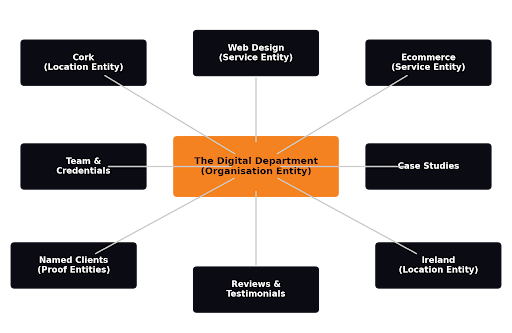 A simplified entity map: one central organisation entity, connected to location, service and proof entities.
Where an Entity Gap Actually Costs You: A Real Example
This is not theoretical. We ran into a textbook entity problem on our own website earlier this year. We have a homepage, a dedicated Cork web design, and a dedicated Ireland-wide web design page. In entity terms, those should be three distinct things. A business, a location-specific service, and a nationwide service.
The homepage and the national page overlapped so heavily in their copy that Google could not confidently tell them apart. It defaulted to ranking the homepage for national search terms the dedicated page was actually built to own.
The fix was not more content. It was clearer separation. Distinct opening statements, distinct FAQ questions, distinct client examples for each page, so each one became an unambiguous answer to a different question.
| REAL RESULT After separating the Cork and Ireland entities more clearly across two pages, national terms like “web design ireland” and “web design agency” moved from position 11 to 32 into position 4, and “website design company” moved from position 10 to position 1. |
A Second Example: What AI Engines Actually See
Ranking recovery is one signal. Whether AI engines actually cite and name you is a separate, more direct one. On our own account this month, ChatGPT, Google AI Overview, Google AI Mode and Gemini all returned very different ratios of pages cited to businesses actually named.
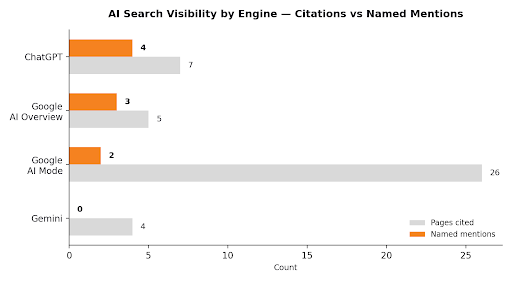 Citations vs named mentions by engine. Our own account, current month.
The gap between the grey bars and the orange bars tells the story. Google AI Mode is crawling and citing 26 of our pages, by far the most of any engine, but converting that into only 2 named mentions.
That is not a visibility problem. It is an entity-trust problem. The content is being read, but it is not yet clear or citable enough to be the thing an AI model names.
ChatGPT cites fewer pages (7) but converts more of them into mentions (4). It seems to reward pages with a clearer, more quotable direct-answer structure.
How We Use Search Console Data to Build Internal Entity Structure
Schema markup gets most of the attention in entity SEO conversations, and it matters. But the internal linking underneath it is what actually teaches Google which pages represent which entities, and how important each one is.
Step 1: Find where trust is already growing
Pull the Pages report from Search Console and rank every page by impression growth over the last quarter. This shows which entities Google is already trying to surface more often, whether or not the site currently supports that with internal structure.
Step 2: Cross-reference against internal link support
For each fast-growing page, count how many internal links point to it, and with what anchor text. A page with fast-growing impressions and thin internal link support is a page Google wants to trust more than the site is currently telling it to.
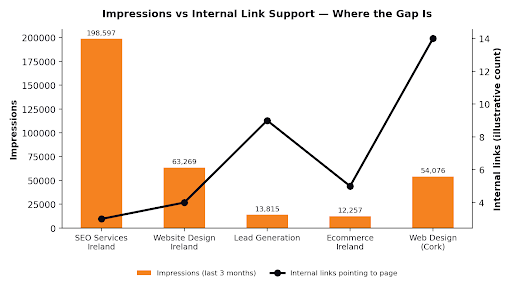 Pages gaining impression share faster than their current internal link support. The gap this process is built to close.
Step 3: Close the gap with intent, not volume
Add contextual internal links from relevant, already-strong pages, using the exact entity name as anchor text. For example, linking the phrase SEO services in Ireland directly to that page, rather than a generic “learn more” link, which carries no entity signal at all.
One well-placed, well-worded link from a strong page does more for entity clarity than a dozen generic links scattered through a footer.
| “Search Console data does not just tell you what is working. It tells you what Google is already trying to trust, before you have given it a reason to.” |
How We Reinforce Entities With External Signals
Internal structure only gets you so far. An entity that only your own website vouches for is weaker than one confirmed independently elsewhere. External signals are how AI tools cross-check what your site claims about itself.
- Consistency across directories and citations. Business name, address and phone number should match exactly across Google Business Profile, industry directories and any press mentions.
- Reviews and third-party validation. Star ratings and named review content are a trust signal AI tools weigh directly, not just a conversion nudge for human visitors.
- Earned mentions and links from relevant, topically related sites. A mention from a genuinely related Irish business publication carries more weight than a large volume of unrelated links.
- Digital PR and case study placement. A named client outcome, picked up and referenced elsewhere, turns a claim into a corroborated fact.
Each of these confirms something your own site already says about itself. That corroboration is what turns a claim into a fact an AI model is willing to repeat.
Entity SEO at Scale
All of the above is straightforward for one or two pages. The real test is whether it holds up across forty, fifty or a hundred pages without becoming unmanageable.
- Build a single entity map first, before writing or restructuring any pages. Retrofitting entity clarity onto an already-tangled site is far slower than designing it in from the start.
- Use page templates with schema built in by page type, so every new page inherits correct markup automatically.
- Re-run the impression-versus-internal-link check monthly. Entity trust shifts as content and rankings shift, so last quarter’s gap is rarely this quarter’s gap.
- Assign one page as the owner of each entity in writing, so nobody accidentally creates a second page competing for the same one.
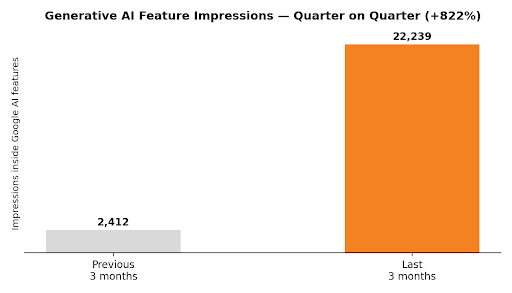 Impressions inside Google’s own AI features, quarter on quarter. Our account, current reporting period.
This kind of shift rewards structure over speed. The 822% jump above did not come from writing more pages faster. It came from Google trusting the entities already on the pages that existed, once the internal linking and schema work caught up to what the content was already trying to say.
A Simple Entity SEO Framework You Can Follow
You do not need an enterprise SEO team to start applying this. Five steps cover most of the ground.
- 1. List your entities explicitly. Write down every distinct service, location and proof point your business has. Do not assume they are obvious from context.
- 2. Give each entity one home. One page per service, one page per location. If two pages could answer the same question, that is a gap waiting to become a ranking problem.
- 3. Mark them up. Organisation, LocalBusiness, Service and FAQPage schema, matched word for word to the visible page content.
- 4. Link them together on purpose. Use Search Console data to find which entities are gaining trust faster than they are gaining internal support, and close that gap first.
- 5. Confirm them externally. Make sure directories, reviews and any earned mentions say the same thing about you that your own site does.
For the technical side of step three, Google’s structured data documentation and schema.org are the two references worth bookmarking.
Common Mistakes We See
- Treating the homepage as the answer to every question, rather than a hub that points to the real answers.
- Schema that does not match the visible page copy. This actively erodes trust rather than building it.
- Generic internal link anchor text, such as “click here” or “learn more”, which carries no entity information.
- No named proof. Client names, sectors and outcomes are what let an AI model justify a recommendation.
- Inconsistent business details across directories and citations, quietly undermining the entity the website is trying to build.
Frequently Asked Questions
What is entity SEO?
Entity SEO is the practice of making your business, services and locations explicit and verifiable to search engines and AI tools, using structured data, consistent messaging and clear internal linking, rather than relying on keywords alone.
How is entity SEO different from traditional keyword SEO?
Keyword SEO focuses on matching search terms to page content. Entity SEO focuses on helping a search engine or AI model understand what your business actually is, so it can confidently cite or recommend you, not just rank a page for a phrase.
Does entity SEO require new content?
Not always. In our own case, the fix was reorganising and clarifying existing pages, not writing new ones. Separating overlapping entities usually matters more than adding volume.
What is AEO and GEO, and how do they relate to entity SEO?
AEO (answer engine optimisation) is about structuring content so it can be extracted as a direct answer, for example through FAQPage schema. GEO (generative engine optimisation) is about being the source an AI model cites when generating an answer. Entity SEO underpins both, since a model needs to trust what your business is before it will cite or recommend you.
How long does it take to see results from entity SEO?
In our own case, national keyword positions improved within a few months of separating overlapping pages. Results depend on how large the entity conflict is and how much internal and external signal already exists.
Do I need a developer to implement entity SEO?
Some schema implementation benefits from developer support, but the core work, mapping entities, writing distinct page copy and building contextual internal links, can be done without one.


 Quick Enquiry